2008 - Age of Awakening / 2016 - Age of disclosures / 2021 - Age of Making Choices & Separation / Next Stage - Age of Reconnection and Transition! /
2024 - Two millenia-old Rational Collectivist societal cycle gives way to the Self-Empowered Individualism. /
2025 Golden Age begins
Global narratives and "theories of everything" are always false! Only Personal Narrative is true!
Showing posts with label monkey regression. Show all posts

Thursday, January 17, 2013

Prosocialites vs neurotics

.

In my previous articles I wrote about a theory postulating that our human ancestors broke away from a "herd of apes" collectivistic lifestyle.  Escaping out of a jungle "paradise" where no work was necessary for acquiring food but social interplay and obedience to herd hierarchy and the group authority was paramount for survival  [Sapolsky 1 and 2 ], meant a change over from the collectivistic towards an individualistic nomadic lifestyle.  The lifestyle where one's survival depended more on the individual foraging, hunting and toolmaking skills, as well as one's ability to construct shelters and make warm clothing.    Human development meant shift from social herd animal to industrious self-reliant individual.  It does not mean shift from social life to a complete absence of social life but it does mean interacting with smaller and more mobile groups that is characterized by less rigidity, less formal hierarchy and exhibits flexible social interactions.

The following recent study has illustrated this surprisingly well:


According to a report summarizing years of research, the Big Five – which include openness, conscientiousness, extraversion, agreeableness,   and   neuroticism – may be a culturally driven model that only really holds true for people in developed, western countries.
...
In his paper, UCSB anthropology professor Michael Gurven details how he and his team were unable to apply the Big Five model to the indigenous hunter-gatherer Tsimane people. Instead, they report, the personalities of the Tsimane appear to be characterized by a “Big Two” pair of traits – prosociality  and  industriousness. And while they report that these Big Two appear to combine certain elements of the Big Five that are used to describe Americans and Europeans, these two core personality traits seem to be a reflection of features that are specific to highly social, subsistence-based societies.

(Note: color highlights are mine)

The fact is, modern academic social science has blown up the pro-social (collectivistic) trait into multiple sub-categories, such as "openess", "consentiousness", "extrovertion" and "agreeableness".  Unsurprizingly, given who they are, the social scientists have shoved the entire multiverse of individualistic traits and skills into just one bin called "neuroticism"!  Why didn't they just call them "nerds" instead?

This study tells us that the social scientists and probably a majority of the society (4 out of 5 perhaps?) has devolved a "stuck in the past" mindset that considers collectivistic prosocial traits of more relevance than the "industriousnes" - pardon "neuroticism".   This is in stark contrast to the stone age people like the Tsimane tribe, whose "industrious" members are described with relevant word, while their pro-social members are bunched into one category rather than splitting them into different party-going monkey categories.

Stan (Heretic) aka Nerd

Saturday, October 30, 2010

Scientists Find Liberal Gene?

.

UCSD Paper:
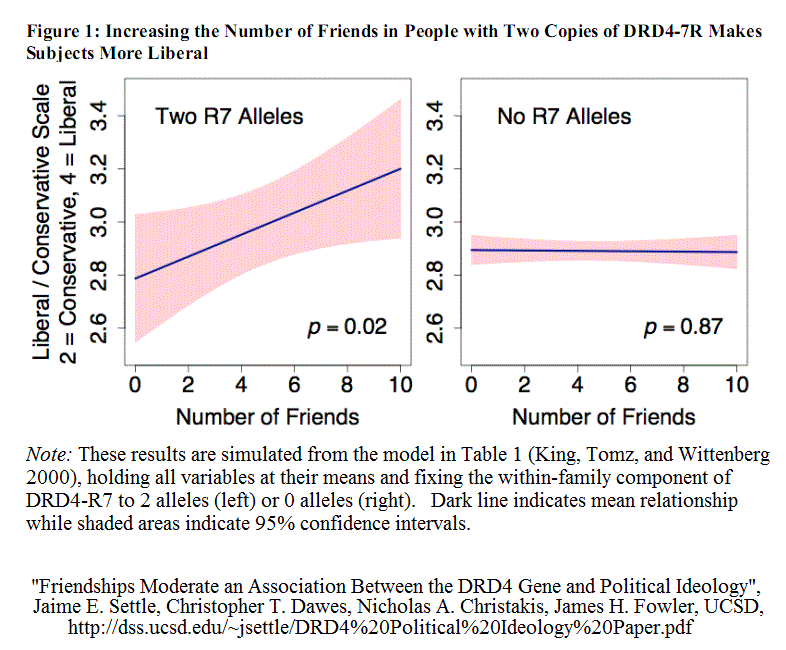
Friendships Moderate an Association Between the DRD4 Gene and Political Ideology
by Jaime E. Settle [jsettle at ucsd.edu], Christopher T. Dawes, Nicholas A. Christakis, James H. Fowler


Quotations:


"It is the crucial interaction of two factors - the genetic
predisposition and the environmental condition of having many friends
in adolescence - that is associated with being more liberal,”
according to the study.
...

Here, we link our understanding of the genetic basis of political ideology with
environmental factors known to influence political attitudes. We suggest that individuals with the 7R allele of the DRD4 gene, given certain environmental stimuli, are more likely to have a liberal ideology.

...
The 7R allele of the DRD4 gene is known to be associated with several haracteristics, such as increased extraversion, novelty-seeking, and sensation-seeking (Eichhammer et al. 2005).
...

In a landmark piece synthesizing five decades of research on conservatism and social-cognitive motives, Jost et al. (2003) assert a motivational basis for the stable, definitional core of conservative ideology, claiming that conservative ideologies are adopted in part to satisfy a variety of social, cognitive, and psychological needs. The authors write that people’s response to threatening environmental stimuli, such as fear and uncertainty, affects the development and expression of political beliefs concerning the core components of conservative ideology, such as resistance to change and acceptance of inequality (p. 366).

We would expect to find a negative correlation between traits associated with DRD4-7R and a conservative ideology if conservatives perceive new experiences as a threat and thus, to satisfy their psychological needs, they avoid novelty and sensation seeking. This has been demonstrated in the literature with sensation seeking (Kish and Donnenwerth 1972, Kish 1973), a taste for broad-mindedness (Feather 1979, Feather 1984), and openness to experience (Pratto et al. 1994, Jost and Thompson 2000, Peterson et al. 1997, Peterson and Lane 2001).
...

Novelty-seeking should not necessarily lead one to make more friends - those high in the 7R allele often exhibit certain asocial behaviors. Rather, the influence of a large number of friends could serve to develop social cognition (Staub 1995), create a better understanding of other’s needs (Niebrzydowski 1995) and greater consideration in regard to the society in which they live (Selman 1990, White et al. 1987), as well as increase expression of prosocial behaviors (Hartup 1993).
...
It is the combination of the desire for new experience and many different pathways to these experiences that we hypothesize has an impact on political ideology.

-----
(See also this article.)

I find it fascinating that a dychotomy between different types of characters comes out even through genetics!  It makes me think that a difference between the two classes of population goes deeper than just "liberal" and "conservative" views in the political sense. The authors identify the liberal view as the one associated with openess, curiosity and a willingness to embrace new experience, where as the conservative is described as perceiving new experiences as threats, thus, to satisfy their psychological needs, they avoid novelty and sensation-seeking, and tend to "accept inequality" - meaning acceptance of the class hierarchy and the authority I presume.

This is not quite the way I see it, based on my experience. Since I grew up in a communist state before moving to the West, I have noticed an awful lot of Western "Liberals" (in the American sense of this word) exhibiting anything but curiosity and openess, while some of the poster "boys" and "girls" of  Conservatism ("Neocons" as they are being fondly nicknamed), seem to have been more open to new ideas or willing to "rock the boat".


I think a more accurate way of political labelling is to use the European meaning for "Liberalism" = pro individual freedom. In the US language it would be called "Libertarianism". European Liberals have always been unafraid and willing to entertain new ideas while the European "Conservatives" were those interested in preserving the power of the oligarchies and their institutions thus any new ideas were generally regarded as harmful.  On the other hand, in the North America, the Conervatives seem to consist of an unworkable - "unholy" mixture of the European style Conservatives and Libertarians.

I see a much more fundamental split in the present society, along the lines of "open and individualistic" versus "closed and hierarchical" that fits the above described model better than the political divide. I wrote about that in the following posts:

Human regression, anthropology

Baby boomers' monkey business 

It is not just as much about socializing and having many friends versus being a recluse - it all probably depends whom you have to deal with! If one is mostly surrounded by the members of a not-ones-own types then obviously, that person isn't going to spent as much time socializing, as he/she would have liked. Each type is as sociable as the other one but on their own terms!  They probably perceive (mutually) any social or societal/civic/business activities of the other kind as boring, unnatural, fake or criminal.  I know I do!

.